11/25/2015

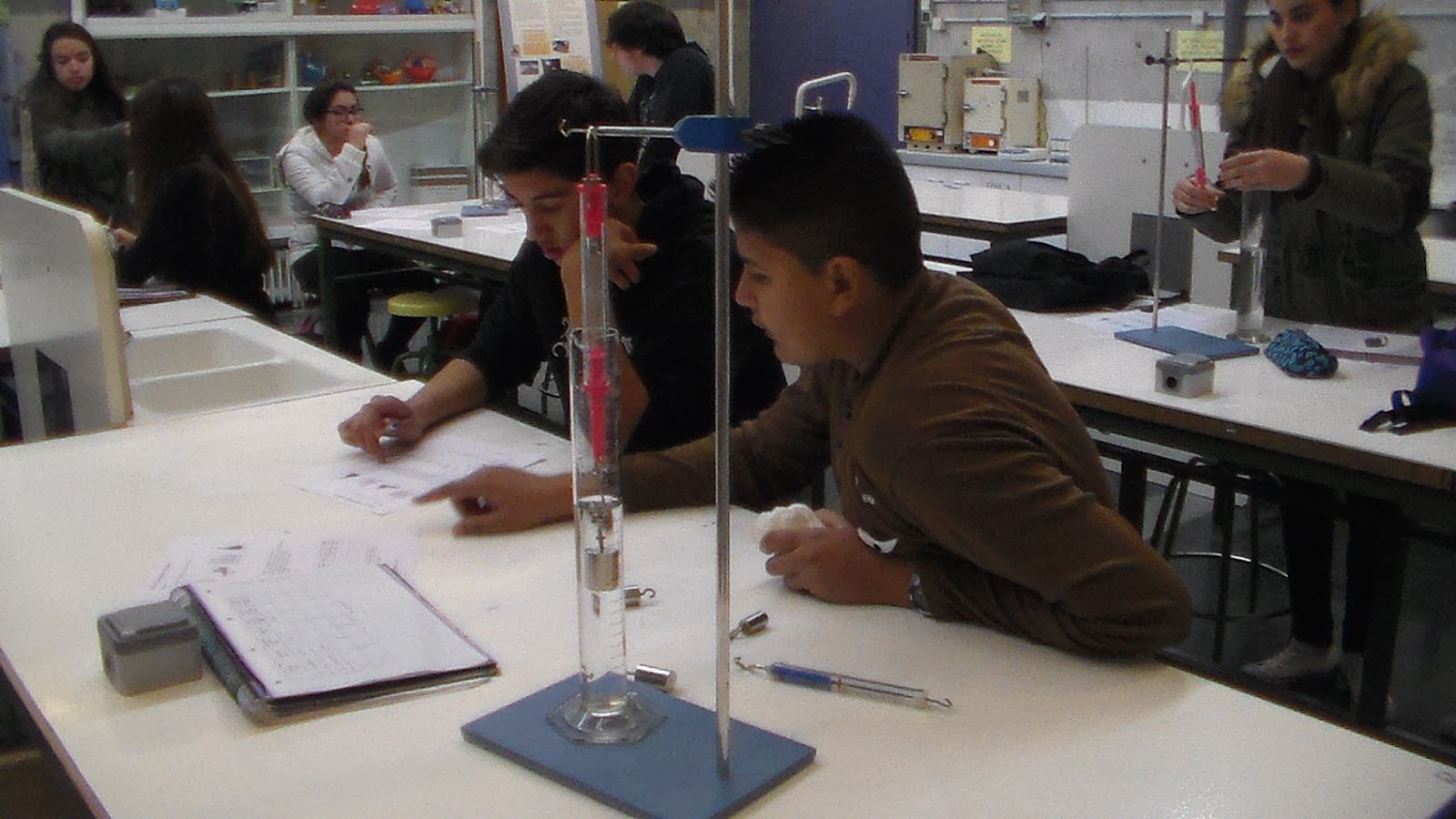
Checking the Archimedes' Principle


Today we have been working on a lab practice to check the validity of the Archimedes' principle.

Did you know that he could work out the density (or specific gravity) of an object by comparing the object’s weight to the weight of water it pushes out of a jar when completely it was submerged?

11/19/2015

The role of saliva in digestion (part 2)


Today we have finished the lab practice to find out if saliva in involved with digestion.

Did you know that saliva contains amylase, an enzyme which helps break down starch and turn it into glucose?

11/18/2015

Kinetic energy versus potential energy


Today we have worked with the concepts of potential energy and kinetic energy. We have used a set of formulas to calculate each.

Did you know that energy is measured with Joules? They are named after Sir James Prescott Joule.

11/12/2015

The role of saliva in digestion (part 1)


Saliva is very important for digestion. Today we have done a lab practice to understand how saliva helps break down polysaccharides into monosaccharides.

Did you know that Lugol's iodine is very helpful to detect starch and Fehline's solution can help you to detect glucose?


10/29/2015

Observing human tissue


Today we have observed human tissue on the microscope to identify its structures. This time we have worked with samples from our oral mucosa and we have observed them at different magnifications.

Did you know that methylene blue helps us see the cells on the microscope better because it stains them?

10/28/2015

Archimedes' principle review


Today we have been reviewing the Archimedes' principle and applying formulas related to the forces of upthrust and weight.

Did you know that ships float because the boat is less dense than the water, so it displaces a mass equal to its own instead of sinking?

10/22/2015

Parts of the microscope


Today we have checked the parts of the microscope and we have had time to look at some samples.

Did you know that the earliest microscopes were called "flea glasses" because they were used to study small insects?